






.png?width=209&height=314&name=Blog%20Portrait%20(16).png)
Are you team cash flow or team appreciation?
There are plenty of debates (and outright rivalries) in the world of real estate investing. Both sides make good points, while also missing the point.
REI Nation has been with investors through the Great Recession and through COVID, and one thing we know for certain: lasting wealth doesn’t differentiate between cash flow and appreciation.
SFR investors put themselves in a better position when they understand what to value and when, and how to see all the returns they’re getting from their investment.
The 3 Pillars of SFR Returns
Single-family rental investing generates wealth through three distinct mechanisms, each doing different work at different points in your hold period:
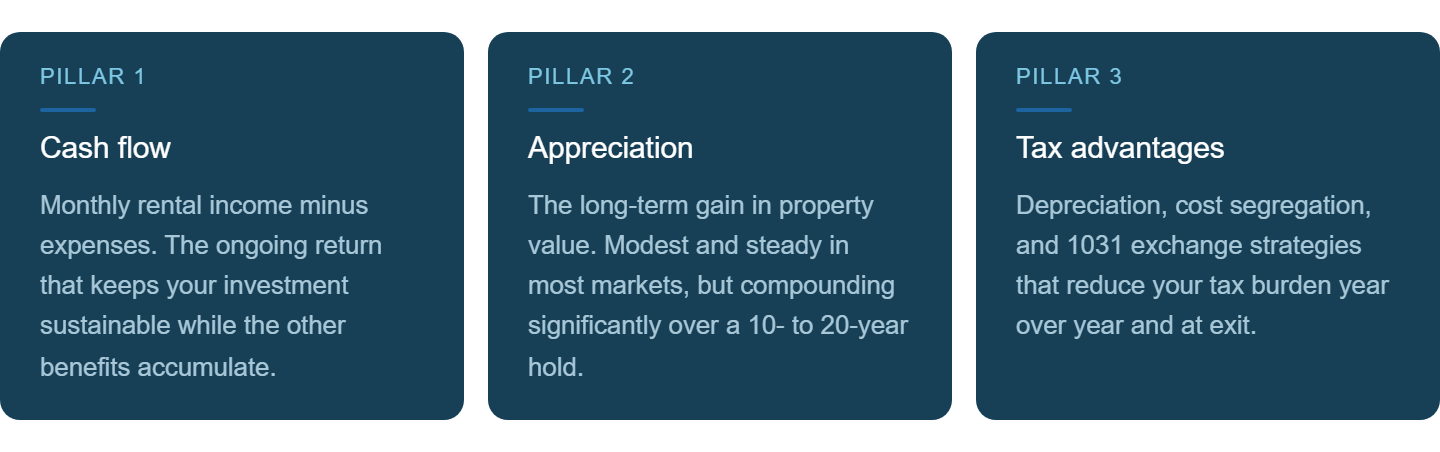 Investing with only one of these in mind leaves money on the table. More importantly, it leads investors to misread their own results, especially early on.
Why the Early Years Can Fool You
New investors often set themselves up for disappointment by benchmarking success too narrowly, too soon.
If cash flow is your only metric and your first property produces $150 a month after expenses, it might not feel like much. Especially considering what you paid for the acquisition. If appreciation is your only goal, you may feel like nothing is happening for the first few years. By either single-pillar measure, early results look underwhelming.
But if you look at the whole picture, depreciation is offsetting rental income on your taxes, often making that $150 cash flow considerably more valuable on an after-tax basis.
Your resident is paying down your mortgage each month, building equity you haven't contributed a dollar toward. And the property itself is quietly gaining value in markets with strong long-term fundamentals.
The early years aren't underperforming; the returns are just distributed across multiple mechanisms that take time to become visible.
A property that generates modest cash flow, appreciates, and produces tax benefits is doing its job.
How the Balance Changes Over Time
One of the less-discussed dynamics of long-term SFR investing is that the relative weight of each return driver changes over time.
In the early years, tax advantages do the heaviest lifting for many investors, particularly those who use accelerated depreciation strategies such as cost segregation studies. Cash flow may be modest while mortgage payments are high relative to rental income.
As you move into years five through ten, the mortgage balance decreases, and rents typically rise with inflation and market conditions. Cash flow improves. Equity builds. And appreciation, which looked flat or incremental in year two, starts to truly impact your net worth positively.
By year ten or fifteen, an investor in a market like Memphis, Dallas-Fort Worth, or Huntsville is often sitting on a property worth considerably more than they paid for, with much stronger cash flow than in year one, and a depreciation schedule still working in their favor. At that point, a 1031 exchange can allow them to roll proceeds into a larger property while deferring capital gains taxes entirely.
Read more about 1031 Exchange rules here.
Then, Scaling Multiplies Everything
A single property working across all three pillars builds wealth just fine, but multiple properties doing the same thing simultaneously make the strategy transformational.
When you add a second or third property, you're stacking depreciation deductions, building equity across multiple assets at once, and spreading appreciation gains across a broader base.
Each property operates independently, but the combined effect on your net worth, tax position, and passive income grows faster than any individual property could.
Diversifying across markets strengthens this further. An investor with properties in Memphis, Oklahoma City, and Birmingham isn't just hedged against a single market's slowdown — they're capturing different appreciation cycles, rent growth trajectories, and economic drivers simultaneously. When one market is in a slower period, others may be accelerating.
This is why REI Nation investors who stay the course and continue adding properties tend to see results that feel disproportionate to the effort involved. The properties are each doing their own work in parallel, while patience and intentional growth are doing the rest.
How Do Successful SFR Investors Measure Success?
The practical implication of the three-pillar model is that investors need to track all three returns, not just the most immediate one.
That means knowing your cash-on-cash return and cap rate, but also understanding how depreciation affects your taxable income, tracking equity accumulation alongside monthly income, and keeping an eye on long-term market appreciation trends in the markets where you're invested.
It also means giving yourself permission to be patient. Buy-and-hold investing is not a strategy that rewards people who check their scoreboard every 90 days. It rewards people who understand what they own and stay the course while the returns compound across all three pillars.
Define what success looks like before you close on a property, and make sure that definition accounts for all three dimensions. If it does, the early years will feel less like disappointment and more like building the foundation of a world-class portfolio.
Ready to put all three pillars to work? Your REI Nation Portfolio Advisor can walk you through what a well-structured SFR investment looks like across your specific time horizon and goals.


.png)
-1.png)