







.png?width=209&height=314&name=Blog%20Portrait%20(11).png)
Ask any seasoned real estate investor why they got into real estate, and taxes will come up quickly.
Depreciation is chief among the reasons buy-and-hold real estate investing is in a class of its own when it comes to tax efficiency. Yet many newer investors don't fully understand how it works, why the IRS allows it, or how to use it strategically.
Let's fix that.
The Basic Mechanics of Depreciation
Depreciation is the IRS's acknowledgment that physical assets wear out over time.
Because a rental property is used for income-producing purposes, the government allows you to deduct a portion of its cost each year to account for that theoretical "wear and tear" — even when the property is appreciating in market value.
For residential rental properties, the IRS uses a straight-line depreciation schedule of 27.5 years. That means you take the depreciable value of the property (the purchase price minus the land value, since land doesn't depreciate) and divide it by 27.5. The result is your annual depreciation deduction.
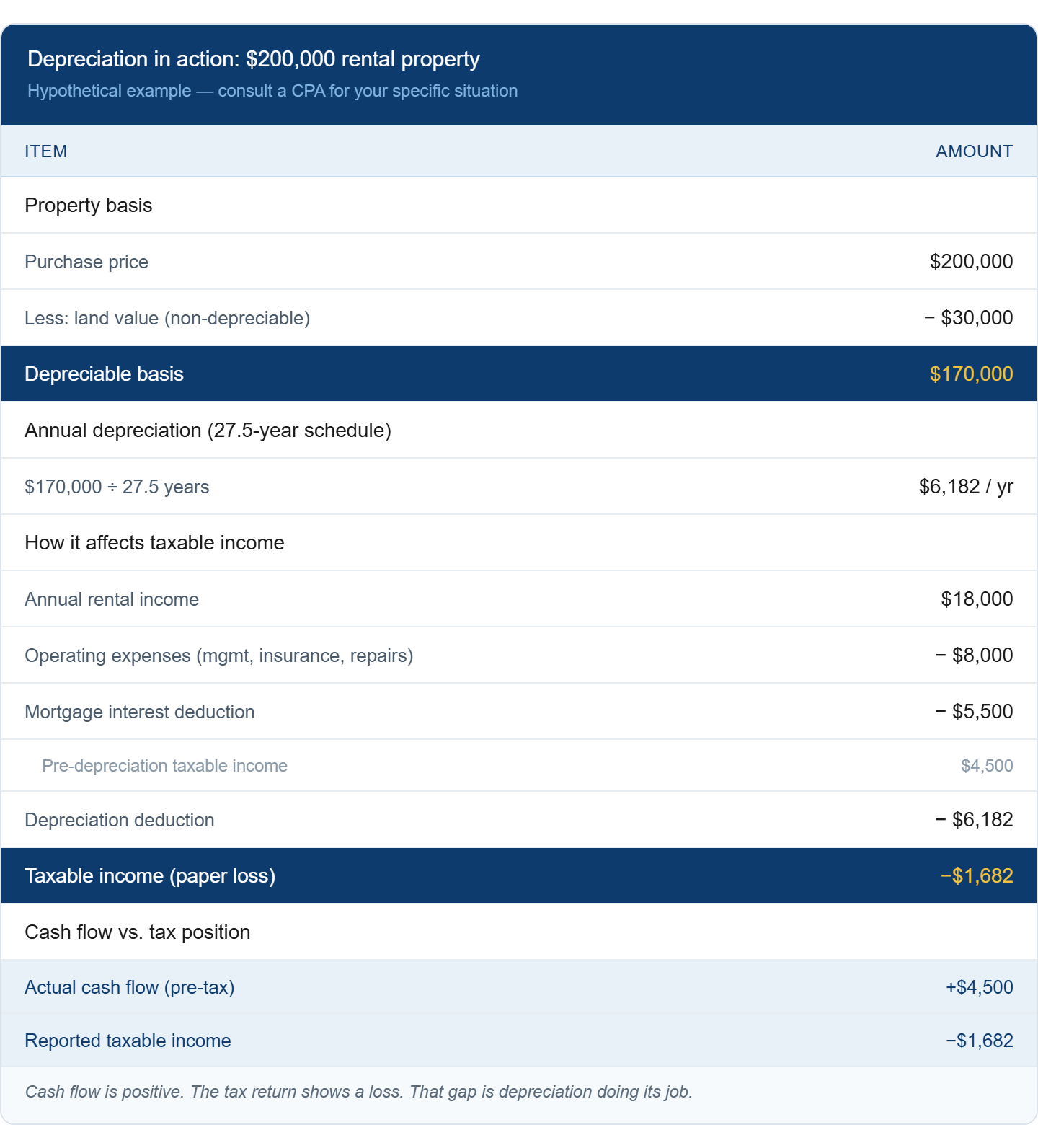
Say you purchase a rental home for $200,000. The assessed land value is $30,000, making the depreciable basis $170,000. Divide that by 27.5, and you get roughly $6,182 you can deduct each year.
When A Paper Loss Pays
Depreciation is a non-cash deduction. You're not spending money to claim it. If your property generates $18,000 in annual rental income and you have $8,000 in actual expenses (mortgage interest, insurance, property management, repairs), you'd normally report $6,000 in taxable income. But add in that $6,182 depreciation deduction, and your taxable income drops to near or below zero on paper.
Your cash flow may be positive while your tax return shows a loss, called a paper loss. For many buy-and-hold investors, this is one of the defining advantages of the asset class.
That said, there are limits based on your income level and whether you qualify as a real estate professional.
For passive investors earning over $150,000 in adjusted gross income, passive activity loss rules may limit how much depreciation you can use in a given year. Those suspended losses don't disappear, though. They carry forward and can be applied in future tax years or upon the sale of the property.
A qualified CPA who specializes in real estate can help you make the most of depreciation in your situation.
Depreciation Recapture: The Trade-Off
There's a flip side: when you eventually sell a property, the IRS requires you to pay taxes on the depreciation deductions you've taken over the years. This is called depreciation recapture, and it's taxed at a maximum rate of 25%, separate from capital gains tax.
This isn't a reason to avoid depreciation, but it’s a reason to plan ahead. Many investors use a 1031 Exchange to defer both capital gains and depreciation recapture by rolling proceeds into a new like-kind property.
Others hold properties for decades or pass them to heirs, who receive a stepped-up basis that effectively eliminates the recapture liability.
Ultimately, depreciation is a tax-deferral strategy, not a tax-elimination strategy. Used with intention, the long-term benefit far outweighs the eventual recapture. Buy-and-hold investors are in the absolute best position to benefit from depreciation.
Accelerating It: Cost Segregation
Buy-and-hold investors seeking to maximize depreciation benefits in the early years of ownership should be aware of cost segregation studies.
Rather than depreciating the entire property over 27.5 years, a cost segregation analysis breaks the property into its components (flooring, appliances, HVAC systems, landscaping, and certain fixtures), each of which may qualify for shorter depreciation schedules of 5, 7, or 15 years.
The result is a front-loaded deduction that can significantly reduce taxable income in the years immediately following acquisition. This is particularly useful for investors scaling a portfolio, as accelerated deductions can offset income from multiple properties.
Cost segregation studies are conducted by engineering or accounting firms at a cost, so they're most worthwhile on higher-value properties or larger portfolios. Your CPA can help you assess whether it’s worth doing.
Why Buy-and-Hold Investors Win Here
Depreciation rewards patience.
You claim it every year you hold the property. Stack that benefit across multiple properties over multiple years, and the cumulative tax shield is substantial. Combined with cash flow, appreciation, and equity growth, depreciation is one of the structural reasons long-term real estate investors build wealth at a pace other asset classes just can't match.
This is precisely why a buy-and-hold strategy — not flipping, not short-term speculation — unlocks the full potential of real estate investing.
If you're not yet maximizing depreciation on your rental properties, it's time to have that conversation with a real estate-savvy CPA.
Ready to build a portfolio designed for long-term wealth? Talk to a REI Nation portfolio advisor and explore what turnkey investing can do for you.


.png)